
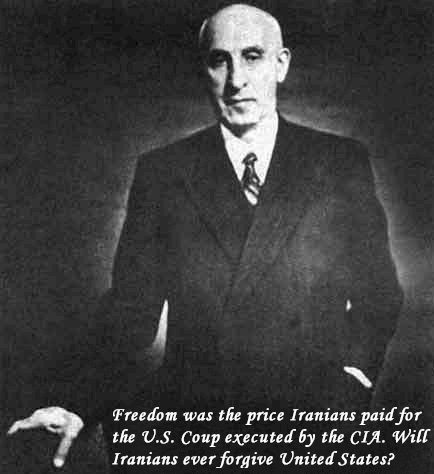
Dr. Mossadegh, Democratically Elected Prime Minister of Iran (1951-1953)

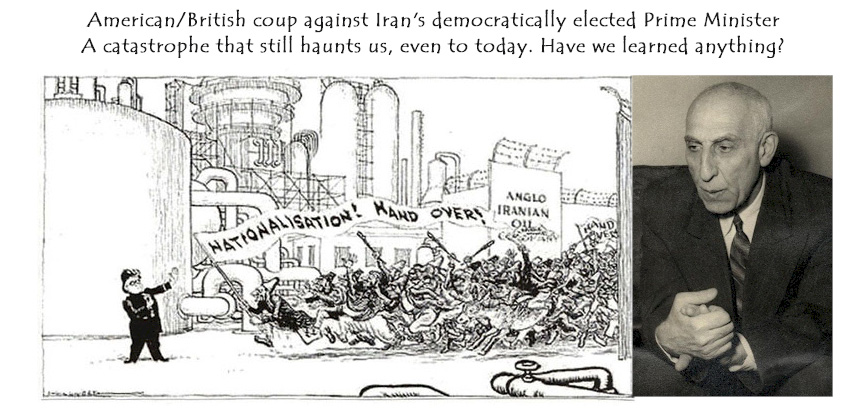
What would middle east look like today if CIA had not overthrown Dr. Mossadegh?
In 1923 a survey was conducted by the Research Institute of Collège de Sorbonne in France (now University of Paris) regarding the most hated country and government on earth.
You would be surprised to hear which country won the prestigious award.
Imperial Britain.
Why Britain?
Dr. Mohammad Mossadeqh (19 May 1882 – 5 March 1967) was a major political figure in modern Iranian history who served as the Prime Minister of Iran from 1951 to 1953 – the man whom Time magazine had called “The Iranian George Washington” – represented for Iranians a symbol of change, a champion of true secular democracy, and regarded by many Iranians as the only true freedom (political, individual, and religious) in 200+ years since Persian Safavid Dynasty that ended in 1722.
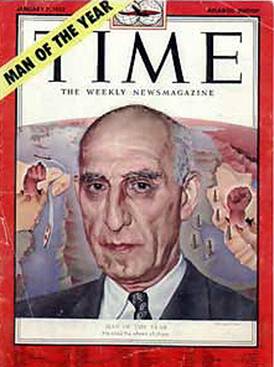
Born in 1882 to an aristocratic family, Mossadegh studied law in France and Switzerland and participated in Iran’s constitutional revolution in 1906. By the time he was elected prime minister, in 1951, he had been involved in Iranian politics for half a century and was admired by Iranians for his experience and integrity.
Little wonder that Iranians today continue to mourn the 1953 downfall of Mohammad Mossadegh, who is widely considered the most visionary and broad-minded leader in Iran’s modern history. He is regarded at the honest, old nobleman that most Iranians regard as the symbol of greater freedoms and fair elections. To them, Mossadegh is still the personification of these ideals. If not for the CIA-backed coup that removed him, many Iranians believe, he could have saved them from decades of dictatorship, demagoguery, and the torture and killing of 143,000+ dissidents murdered by the U.S./Britain installed puppet government of the Shah. I's hard to see how Iranians could one day again trust or see U.S. or Britain as a friend or as a flag-bearer of democracy or justice. Sadly our people have a lot in common and friendship could have had many cultural and economical benefits for all parties.
Even his critics then and still today regard Mossadegh as a prominent figure representing freedom, justice, and democracy in Iran and supported by all those that wanted a free and democratic Iran. He was an author, administrator, lawyer, parliamentarian, and the Prime Minister of Iran and in the West he is most famous as the architect of the failed nationalization of the Iranian oil industry.
The U.S./British coup against Mossadegh left a deep impression on the country – not only on its politics but also on the fact that Iranians will never trust the West again
For 6 decades the Iranian oil and gas resources were taken over by the Imperial Britain through invasions (1st and 2nd World Wars, Iran was invaded and occupied by the Allies), military threats, intimidation, bribery, and coercion and referred to as the Anglo-Iranian Oil Company (AIOC), later known as British Petroleum and now called merely BP.
The British happily bragged that this single control of another country's natural resources was the most profitable British venture in its entire history, amounting to $840 billion (inflation adjusted for 2010) for the duration of 60 years. May be bragging so publically may not be wise as it will continue to insult and intimidate Iranians and remind them of their humiliation.
The Imperial Britain spent its first half of 20th century looting, robbing, and stealing resources of every country it could, including small islands from central Asia, Africa, Middle East, and throughout its colonies from every corner of the world.
The British military and merchant shipping used every means to plunder national assets of other countries and send the proceeds of its military might, interventionism, and political interference of developing countries back to its homeland depriving others of their rightful natural resources and national treasures.
With such inhumane and violent acts as civilian massacres and mass execution of unarmed civilians (Jallianwala Bagh massacre 1919) Imperial Britain ruled with unimaginable brutality and inhumanity. In one of many such incidences, the British Army led by Brigadier Reginald Dyer, opened fire on an unarmed gathering of men, women and children in India whereby firing lasted for 10 to 15 minutes, until they ran out of ammunition.



Again and again the British resorted to injustice and violence resulting in countless numbers of atrocities (Batang Kali massacre, using chemical weapons against Iraqi civilians in 1920 as well as punitive village burning expeditions) the Imperial Britain were bestowed the prestigious award as the most hated country and government on Earth, in 1923 in a people survey conducted by the Research Institute of Collège de Sorbonne in France (today, University of Paris).
The British Empire however resorted to using distorted Machiavellian interpretations to convince its citizens and its supporters that the Empire must resort to using excessive violence for the sake of humanity (despite its twisted contradiction in terms). When "British Subjects", or now referred to as citizens, refused to carry out such acts of violence, the British Empire used, and defended the use of, mercenaries or contract murderers to carry out their devious acts.
When the British were questioned by the International organizations and the people of the world for its inhumanity, they claimed that organized government acts such as political violence, vicious brutality, international manipulation, media disinformation, assassination, and treacherous savagery are actually representation of kindness in cruelty.
Winston Churchill himself has been recorded for his following remarks:
"I do not understand this squeamishness about the use of (poison) gas (against Iraqi people in Basra). We have definitely adopted the position at the Peace Conference of arguing in favour of the retention of (poison) gas as a permanent method of warfare. It is sheer affectation to lacerate a man with the poisonous fragment of a bursting shell and to boggle at making his eyes water by means of lachrymatory gas. I am strongly in favour of using poisoned gas against uncivilised tribes. The moral effect should be so good that the loss of life should be reduced to a minimum. It is not necessary to use only the most deadly gasses: gasses can be used which cause great inconvenience and would spread a lively terror and yet would leave no serious permanent effects on most of those affected."
Documented Source: Winston Churchill, 1919
In 1937, Winston Churchill made of his most provocative (and many people believe racist) comments while in political office. His attitude towards Iran was no major departure from his views of the world, and support for injustice and inequality, and at least to him, the logical path of a higher-grade race over the rights of its victimization of a "lower-grade race".
The dark side of Winston Churchill's legacy many people never knew due to lack of media coverage of the time ...
"I do not agree that the dog in a manger (referring to Palestinians) has the final right to the manger even though he may have lain there for a very long time. I do not admit that right. I do not admit for instance, that a great wrong has been done to the Red Indians of America or the black people of Australia or the Black people in U.S.A. I do not admit that a wrong has been done to these people by the fact that a stronger race, a higher-grade race, a more worldly wise race to put it that way, has come in and taken their place. "
To the Peel Commission (1937) on a Jewish Homeland in Palestine: Documented Source Winston Churchill, 1937
Iranians still claim today that the British Empire's control of Iranian oil resources robbed Iranian children of their birth rights, deprived a nation of its ability to build its infrastructure, and stripped them of their chosen democratic leaders. They feel that millions of Iranians are today buried in their graves robbed of a life that they should have had, if their birth rights had not been stolen. It's hard to argue with that perception, morally, logically, or intellectually.
In a 1984 documentary called the 'Power of the Empire' (by Panorama program on BBC TV), the British finally released classified information as the 30 year non-disclosure policy had expired during the previous year, 1983 (the coup took place in 1953).
Many released documents illustrated the British control of Iranian oil fields with the use of brutality, intimidation, and manipulation of Iranian politics through threat, bribery and coercion and by using its military to close Iranian roads and ports to threaten transportation of food, fuel, and supplies.
During these 60 years, Iranians received less than 1% of their own natural resources and most often these payments were made to only those that were willing to cooperate with the British occupation and control of Iranian oil fields.
"Iranians were deeply angry by the British company, which called itself the Anglo-Iranian Oil Company, and its refusal to accept a fair ‘50–50% profit sharing with Iran as Aramco had with Saudi Arabia", according to Ahmad Sadeghi, Iran's History Professor at University of Stanford.
In both first and second world wars, Iran was neutral and did not act aggressive and had declared neutrality. However, on both occasions the British declared war on Iran, attacked, invaded and occupied and installed a fascist-military puppet government.
Although Britain declared war on Germany in 1939 for attacking, invading, and occupying Czechoslovakia and Poland, in later years and after the formation of United Nations, there was no international body that would accuse Britain of hypocrisy for doing precisely what the Nazis had done.
Dr. Mossadegh was elected democratically in 1951 and his main political agenda was to take back Iranian oil and gas resources from the powerful military of Britain and use the oil revenues to improve the quality of life, education, and the lives of Iranians people. For that he was loved and cherished, then and still today by most of Iranians.
We Americans will probably never understand why the CIA involvement and execution of the coup is so emotional and so vivid still today, in the minds of Iranians, even those who were not even born at that time. Americans just are not able to understand that Iran's oil represented life, hope, and freedom for Iranians who had been subjected to so much injustices and cruelty by the British and the Soviets for a couple of centuries. The American coup will never be forgiven and never be forgotten. It is not just about economic considerations, it is moral ones and represents injustice against millions of Iranians and their national and political aspirations. American presidents and the U.S. Congress and the U.S. State Department officials have never understood this, or at least never modified their policies to take this into account. They continue to think that Iran is unreasonable for hating America after all these years for what U.S. did to Iranian people decades ago. Not a day goes by that Iran is not demonized in the Western media. No one ever asks, why are the Iranians angry with us?
To make the situation even worse, we demonize, dehumanize, cause grievances such as shooting down their civilian airliner, and attack their nuclear civilian program for electricity generation with Stuxnet computer virus to destroy it while we are helping Israel to assassinated 5 of their scientists.
Even more sad than the tragedy instigated by the C.I.A, is the fact that Iranians will one day have their vengeance, as history has proven. We can run, but we can't hide. We have to wait until they are ready, as long as it may take. Whenever. We are just too short-sighted and short-term thinkers that we do not understand a patient country with 7,000+ years of history. We should have paid sooner for our debt to avoid the compound interest. Our arrogance has drafted a cashier's check for our acts of injustice which we can never pay, without pain.
During his 2 year in political office Mossadegh implemented many social changes including freedom of speech, freedom of press, and freedom to organize a political party. His other bills to the parliament, included a retirement planning fund, urban development program, protection of women from abuse, fair taxation laws, and other social and economic development bills. His people never forget this and accuse us of being hypocrites when we accuse the Islamic Republic of Iran of being undemocratic.
Mossadegh represented the Iranian people's aspirations for independence and self rule. After 2 years of freedom, social and economic development, and political reform and progress, the Iranians lost their beloved leader to a U.S. instigated coup carried out by the CIA and on behalf of Britain. I hope Iranians can forgive and I hope we can apologies for our past actions.
Every time I have discussed and debated the issues with my Iranian colleagues in the last 40 years, I was quickly reminded that during the 1951-1953 when Iran attempted to nationalize its oil and remove the British grip on Iranian resources, Winston Churchill ordered the British navy to barricade all the Iranian ports. For two years no food, no milk, and no medicine, were delivered through Iranian ports and no ships were allowed to import or export from Iran. This incident will not leave their memory anytime soon.
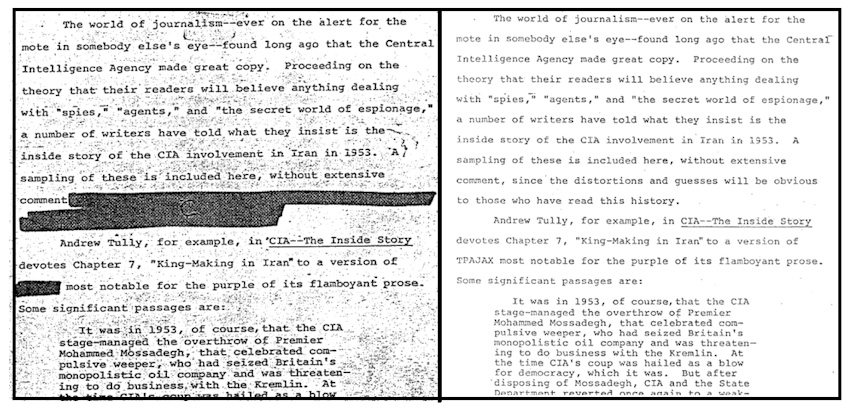
Various classified information has been release by CIA until the orchestrator of the coup, the CIA operative Kermit Roosevelt admitted in his book that the Britain (and in particular Winston Churchill, its Prime Minister) was trying to "starve Iranians into submission or death, whichever comes first as long as eventually Britain gets the oil". The CIA just wanted to remove the possibility of a Soviet influence in Iran.
In Iran and throughout Middle East and some Asian countries, Dr. Mossadeqh is known as a hero of Third World anti-imperialism (British) and victim of capitalist (American) greed.
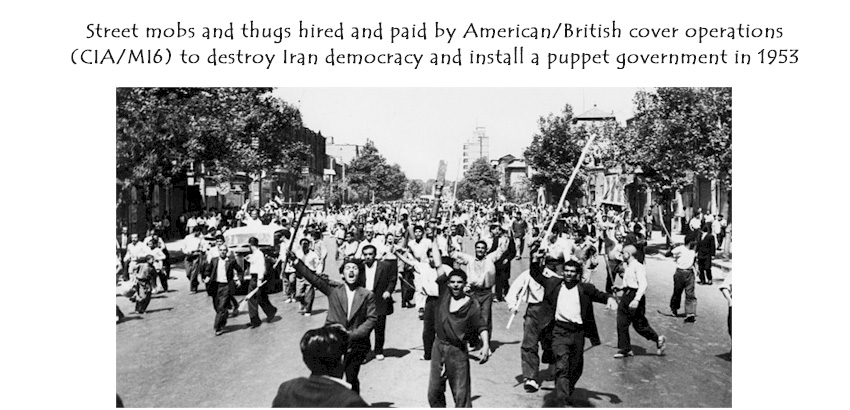
Dr. Mossadegh was removed from democratic power in August 19th, 1953 by a coup d'état instigated, planned, funded and executed by the United States with its operational center based at the U.S. Embassy in Teheran - the site for U.S. hostage crises nearly 27 years later and now referred to by the Islamic Republic of Iran, as the Den of Spies.
The 1953 coup (by American CIA) has spawned a tragic legacy. It has:
(i) proved to be a blowback in American foreign policy and served as one of the major contributors to the continued souring of US-Iran relations;
(ii) worked to directly impede Iran’s indigenous push towards secular democracy and political development;
Documented Source: MIT International Review, 2009
Upon the successful CIA coup, U.S.-Iran relationship has deteriorated, almost as soon as the people of Iran has the slightest power to resist the U.S. installed, fascist military puppet government of the Shah and there has been animosities and counter-acts by both sides (see History Timeline in Iran-U.S. relationship) with no government dialog since the 1979 until recently during the Iran Nuclear Agreement, and still continuing mistrust and hostilities with no end in site.
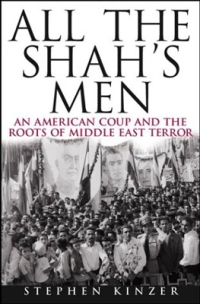
Stephen Kinzer's (The New York Times Pulitzer Winner) and author of ALL THE SHAH's MEN: An American Coup and the Roots of Middle East Terror, points out in his book, "To us Americans, the U.S. coup in Iran is just an intellectual exercise. To Iranians it is something deeply emotional, something they refuse to forget and may always remain the wall of mistrust between Iran and United States".
On June 4, 2009, President Obama made a frank admission in discussing colonialism as one of roots of tension between the West and the Middle East. He stated “the United States played a role in the overthrow of a democratically elected Iranian government. Rather than remain trapped in the past, I’ve made it clear to Iran’s leaders and people that my country is prepared to move forward. “
It is important to note that many Iranians, rightly or wrongly, blame America’s role in the overthrow of the Mossadegh government as one of the chief sources of their country’s subsequent history of authoritarian rule, with its unfortunate side-effects still being felt today. In sum, in August 1953, the CIA imposed a severe blow to Iran’s indigenous steps towards secular democracy and independence.
“Observe good faith and justice toward all nations. Cultivate peace and harmony with all”, words uttered by President George Washington had fallen on deaf years.
The damage has been done. With the benefit of hindsight, one can reasonably conclude that if not for the coup, Iran would have been a different country today, as would Iran-US relations. This understanding is important for American policy makers. The Iran question should not be analyzed in a vacuum divorced from the sour historical realities weighing down on US-Iran relations.
Documented Source: MIT International Review, 2009
Conservative author, Christopher Hitchens writes about the 1953 incident, "... it is an atrocity of August 19, 1953, when the elected nationalist government of Prime Minister Dr. Mossadegh was forcibly removed by an Anglo-American coup that instated the shah as a dictator and returned the country's main natural resource to foreign control".
Carl Rowan, the late African-American journalist writes, "It seems ages ago, in 1962, that I went to Iran with Vice President Lyndon B. Johnson to find a marvelously friendly people and a staunchly allied government. There were not many overt signs that burning in the hearts and minds of many Iranians was a deep resentment that the U.S. Central Intelligence Agency had masterminded a 1953 coup".
Emmy award winning journalist Frank Sesno working for CNN, writes, "Iranians repeatedly point to America's intervention in 1953 when the CIA overthrew a prime minister. They point to U.S. support for the Shah through all those years. They point to the American support for Saddam Hussein throughout 1980s when he was gassing Iranians on the ground. Iranians will say, international conventions, the United Nations, nobody did us any good then, we were on our own, and today we need our own deterrents. Not only do we not trust you, we know you have done us real harm in the past, and present with sanctions and demonization through the media".
With 40 years in broadcast journalism, Emmy winning PBS host, author and political commentator Bill Moyers has one headline to his special program The Constitution in Crisis, and that is: "Mossadegh Held Power Legitimately".
In 1953, the CIA coup was a severe blow to the aspirations of Iranian people and their desire for a democratic and free society under Dr. Mossadegh and independence from foreign powers or as they refer to as, the bully, referring to the the British Empire.
The words of President George Washington, “Observe good faith and justice toward all nations. Cultivate peace and harmony with all”, have been ignored by U.S. policy makers and the CIA directors and their conservative supporters at the State Department and this has been and continues to be the giant dividing wall of mistrust between United States and Iran and any future repercussions directly and indirectly the result of sour actions of previous US-Iran history, prior instigations, and counter-actions and reactions.
Once Mossadegh was removed from power on 19 August 1953, in a CIA coup operation named "Operation Ajax", he was imprisoned for three years and subsequently put under house arrest until his death in 1967. His aspiration for his country's freedom and independence was replaced by the SHAH of Iran, a dictatorship puppet government that served the West's interests until the 1979 Revolution that brought to power the Islamic Republic of Iran.
Did United States and its CIA black ops apparatus consider the important lesson of politics that history has taught again and again: that everything is temporary.
 Children and young adults in higher risk of colon or rectal cancer for the first time, studies show.